 Skip to content










As political parties look to simplify the system in pursuit of growth, Helen Griffiths, Chief Executive of Fields in Trust, argues that nature and community wellbeing must not be left exposed, and sets out how each tier of government can deliver new homes and green space together.
Growth was the buzz word at this year’s party conference season. Whichever hall you sat in, the argument around house building was much the same – Britain needs more homes, faster delivery and a simpler system, with fewer layers to slow down decision-making.
Few people in public service would disagree. Decent, affordable homes are rightly a national priority, and anyone who has tried to get something built knows how much friction the system can create.
But simplification has consequences. Earlier this year, the Government proposed removing Sport England from planning decisions affecting playing fields. This autumn, the Conservatives set out plans to abolish Natural England and the Environment Agency. These are different proposals with different aims, and in the second case it is far too early to know the detail.
My point is one of principle, and it applies to any party and any reorganisation. However the system is reshaped, nature and the wellbeing of our communities cannot be put at risk. Fields in Trust supports the delivery of homes and growth, but never at the expense of critical community infrastructure.
What is at stake
Parks, playgrounds, playing fields and green spaces are not nice-to-haves. They have a direct impact on our physical health, mental wellbeing and quality of life. They are where our children learn to play, where people stay active, and where neighbours meet. They cool our towns in a heatwave, absorb surface water and support nature. Our research puts the wellbeing value of using them at £34 billion a year.
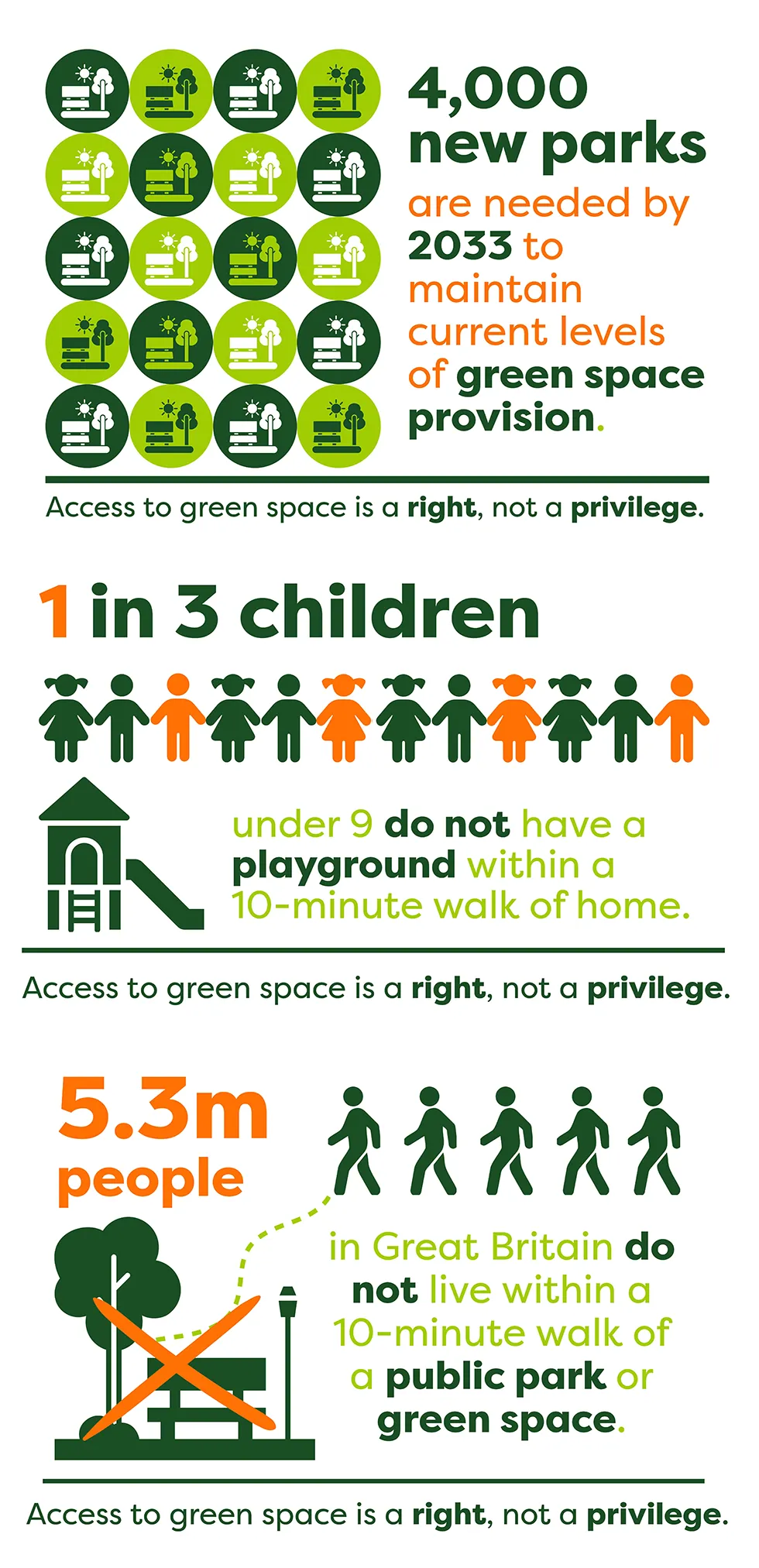
Yet provision is already falling short. Our Green Space Index shows that 5.3 million people in Great Britain live more than a ten-minute walk from a park or green space. Seven of England’s nine regions fail to meet the recommended quantity of green space per person. One in three children under nine has no playground within a ten-minute walk of home.
What we do have is increasingly fragile. The majority of our recreational green space is potentially vulnerable to development, and 226 spaces have been lost since the pandemic. The impact is disproportionate with deprived and moderately deprived areas in England twice as likely to be at risk of losing green space and recreational pitches to development, compared to more affluent areas.
Progress, but not yet protection
There has been real progress. The new National Planning Policy Framework recognises the Fields in Trust Standards as the benchmark for good green space provision. Developers building on green space must still provide replacement land of matching quality and quantity. And after a campaign led by our President, Jill Scott, which brought together 88 governing bodies, grassroots organisations and sports stars, Sport England’s role as a statutory consultee on playing fields remains substantially in tact.
We welcome all of it. But these steps do not go far enough. A benchmark that is referenced but not required will be applied inconsistently, and most green space still has no long-term protection at all.
Proof it can be done
At Priors Hall Park in Corby, the developers of more than 5,300 homes on a former quarry site used our Standards to embed open space and play in the masterplan from the very beginning, working with North Northamptonshire Council. Many of those spaces were delivered before the homes were occupied.
In Liverpool, the City Council decided in 2021 to protect every park and green space in its portfolio, more than 100 spaces in all. Sixteen parks are already secured through our Deed of Dedication, a legal agreement that keeps land in local ownership while securing it for public recreation forever.
Neither place chose between growth and green space. They planned for both.
Three asks for three tiers of government
Our new report, Planning for Growth, Protecting Green Space, sets out how every tier of government can do the same.
National government should make the Fields in Trust Standards a mandatory requirement in planning policy, not simply a reference point. That would give every local planning authority one clear, shared benchmark, closing the gap between best practice and what is required.
Councils and combined authorities should consider long-term protection for their green spaces through the Local Plan, starting where provision is poorest. A Deed of Dedication gives communities a lasting guarantee that valued spaces will remain legally protected, regardless of future political or financial change.
Regional mayors have the power to improve how the funding of green space is prioritised and should direct a share of Integrated Settlement funding towards restoring parks and green spaces in the areas of greatest need. The Green Space Index provides the evidence to do that fairly and consistently.
The public is behind this. Polling for Fields in Trust by YouGov in March found that 86% of UK adults believe accessible green space should be a legal requirement for new housing developments, and 70% see access to green space as more of a right than a privilege. Six in ten think the Government is doing too little to protect playing fields and community sports grounds in the long term.
The 1.5 million homes this country has committed to building will shape communities for generations. I would invite every reader to look up their own area in the Green Space Index, see how it compares, and talk to us about what could be done.
Growth and green space are not conflicting priorities. With the right choices now, at every level of government and from every party, we can deliver both.
About Fields in Trust
Fields in Trust is the UK’s only charity dedicated to protecting parks, playgrounds, playing fields and green spaces in perpetuity. Established in 1925, the organisation works with landowners, local authorities and communities to sign a unique and binding legal commitment (called a Deed of Dedication, or Minute of Agreement in Scotland) that protects green spaces for the benefit of local communities and nature forever. With nearly 3,000 protected sites nationwide, the charity combines legal protection with policy advocacy and research, including its annual Green Space Index. HRH The Prince of Wales has served as Patron since 2024, with former England footballer Jill Scott MBE appointed President in July 2025.
Report: fieldsintrust.org/insights/reports-resources
Green Space Index: fieldsintrust.org/insights/green-space-index
Email: info@fieldsintrust.org
Website: www.fieldsintrust.org