 Skip to content









Luigi Bertino, Product Marketing Manager at Canon UK & Ireland, explores why the NHS’s digital transformation must extend beyond individual systems and why information quality matters.
Digital transformation in healthcare is about people. Technology can create new possibilities, but its real value is measured by what it enables healthcare professionals to do and, ultimately, how it supports better outcomes for patients.
The NHS is investing heavily in digital technology. In July 2026, NHS England accounted for £10 billion1 in technology[SB1.1], digital and data investment over the next three years, with the programme expected to generate around £ 412 billion in benefits over the next decade. The Frontline Digitisation Programme has also invested £1.923 billion to establish baseline digital capability across NHS trusts.
This investment is creating an important foundation. But the next challenge is making sure that foundation works for the people using it.
The workforce challenge behind digital transformation
The NHS continues to face significant pressure on resources and productivity. Digital transformation therefore needs to be more than introducing new systems. Rather, to help healthcare professionals spend less time managing information and more time attending to patients.
There has already been substantial progress as the NHS England’s 2025 Digital Maturity Assessment found that, 93% of providers were using Electronic Patient Record, while only 30% reported having fully integrated bi-directional data flows. The figures relate to data collected between April and June 20254.
This gap highlights an important distinction: having digital systems does not necessarily mean having connected information.
Referrals, correspondence, forms, historical records, and clinical documentation can still enter healthcare environments in different formats. Information may need to be searched for, checked, re-entered, or moved between processes before it can be used.
For staff already under pressure, these seemingly small tasks can accumulate.
The opportunity for digital transformation is therefore not simply to replace paper with digital files. It is to reduce unnecessary administrative work and make information easier to access, understand, and act on.
In other words, technology should give back time.
From paper to digital and beyond
A referral, form, letter, or historical patient record may begin as a physical document.
To create a digital version, the documents need to be scanned accurately, organised and connected using the appropriate process. It may need to be indexed, stored, retrieved, and routed to the right person or system, and this is where information management becomes an important part of digital transformation journey.
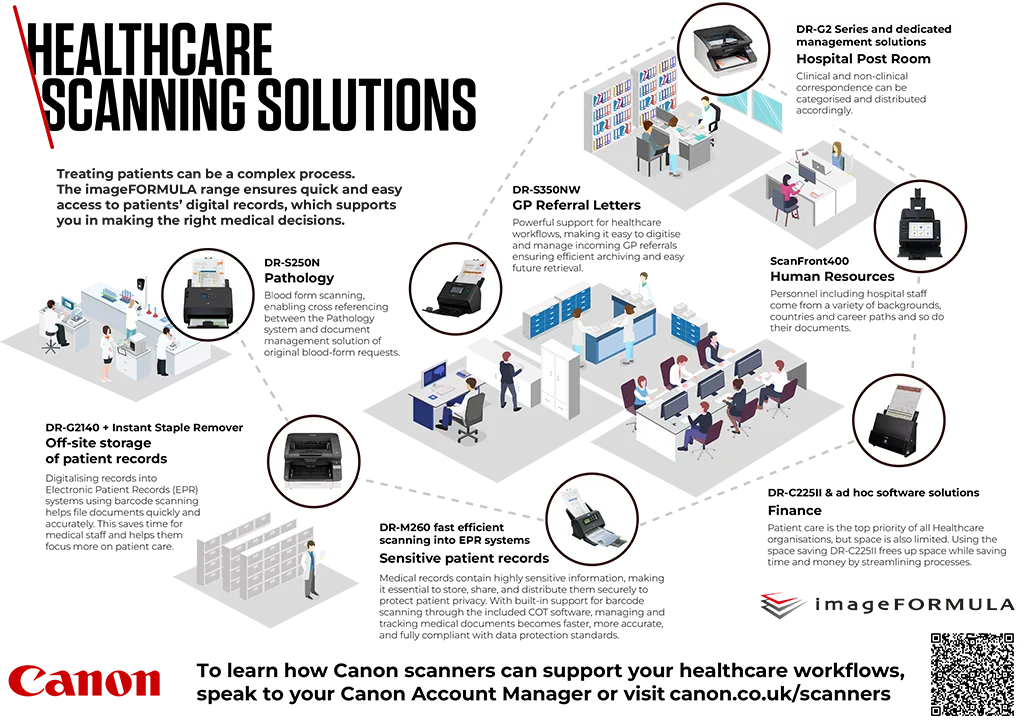
Canon’s imageFORMULA portfolio helps to transfer information from paper to digital workflows; however, capture is only the starting point. The greater opportunity comes from connecting capture with software, workflow automation, and information management.
Therefore™, provides tools to capture, organise, securely store, retrieve and automate information, while integrating with existing business systems. Its workflow capabilities can help organisations digitize processes rather than simply digitise documents.
IRIS technologies, one of Canon’s solutions, provides intelligent document processing capabilities that can capture, classify, extract, validate, and route information from different inputs. This distinction is important because digital documents are not necessarily useful for information. It becomes valuable when it is connected to a process, available to the right person, and usable for the next decision.
Building a more connected information journey
This becomes increasingly important as the NHS moves towards more connected models of care. The Single Patient Record is intended to bring together a patient’s health information in one secure, easy-to-access place, giving health and care providers the information they need to support safer, faster and more coordinated care5.
The objective is not simply to create another digital repository, but to make relevant information available when and where it is needed, and that journey may begin with a physical word document.
When a referral is captured and its contents recognised and extracted, the information can then be classified, indexed, and routed through the appropriate workflow instead of remaining an isolated document – it becomes part of a wider information journey.
For healthcare organisations, this also means considering how new capabilities can work alongside existing IT environments. Information management does not necessarily require every existing system to be replaced. Platforms such as Therefore™ can support integration with existing systems and offer both cloud and on-premises deployment options.
The objective is to connect information more effectively without losing sight of the systems and processes already supporting healthcare organisations.

The next step: making connected information intelligent
Connecting information across NHS systems creates the foundations for the next stage of digital transformation: making information not only available, but more useful. and that’s where Artificial Intelligence (AI) enters the picture.
In July 2026, NHS England announced an accelerated rollout of AI tools and other digital technologies, including AI-enabled support for staff and the development of the Single Patient Records6.
In this scenario, AI could help healthcare professionals find relevant information faster, automate repetitive administrative tasks, and manage growing volumes of information.
However, AI can only be as effective as the quality and reliability of the information it relies on. A referral that has been accurately captured, extracted, validated, and connected to the right workflow is far more useful than a document that simply exists in digital form.
AI should therefore be seen as another capability built on strong information management foundations. Intelligent document processing can turn unstructured information into usable data, while information management and workflow technologies can ensure it reaches the right people and processes. In healthcare, this must also happen within a framework of appropriate governance, security, and human oversight.
At this point, the question is no longer simply how to digitise information, but how to create the conditions for technology to make better use of it.
Making existing investment work harder
This is particularly important given the scale of digital investment already being made across the NHS.
When information can move smoothly between capture, processing, workflow, storage and the systems healthcare professionals already use, digital transformation becomes more valuable.
For staff, this can mean fewer manual steps and less time searching for, re-entering or moving information. For organisations, it can support more consistent processes and better visibility. For patients, it can help ensure relevant information reaches the people who need it when they need it.
This is where the different elements of Canon’s proposition bring it all together to guarantee a seamless information management journey. imageFORMULA scanners provide the initial point of capture; IRIS technologies can help to classify, extract and validate information; and platforms such as Therefore™ can help organise information and move it through the appropriate workflows. Rather than adding another system, the objective is to help connect these stages so information can move more efficiently from capture to usage.
From digital transformation to better outcomes
Ultimately, digital transformation should remain focused on people. Success should not be measured simply by the number of systems deployed or documents digitised, but by what those investments enable healthcare professionals to do differently.
When information moves more effectively between people, departments, and systems, administrative processes can become less burdensome. When relevant information is easier to find and use, professionals can spend more time on work that requires their expertise. And when technology removes friction from everyday processes, it can help give time back to the people at the heart of the NHS.
The NHS is building the digital foundations of future healthcare. Connecting those foundations, and making them increasingly intelligent, is the next step.
References and source links
- NHS England — NHS accelerates artificial intelligence rollout to cut waiting times and improve care for millions (4 July 2026)
- NHS England — Digitising the frontline
- NHS England Digital — Digital Maturity Assessment: Key findings (April–June 2025)
- NHS England — Single Patient Record
- NHS England — Digital transformation
- NHS England – AI rollout announcement
More Information:
Visit our website: click here >